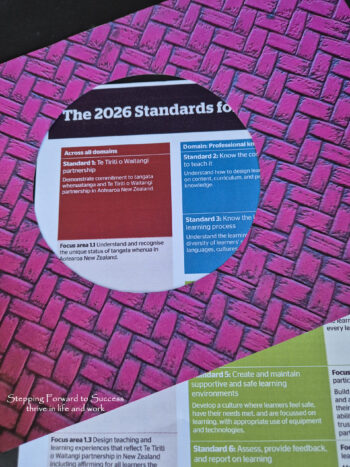
The transition to the 2026 Teaching Standards is more than a structural update.
It represents a significant shift in how we understand our professional teaching identity in Aotearoa.
Previously, we explored what the updated Standards mean for your teaching practice. If you’d like to read more about this, you can check out the article here on the Teaching Standards article.
We discovered that one of the most profound changes within the new 2026 Standards is the repositioning of Te Tiriti o Waitangi.
It is not something that sits alongside our practice; it lives within it.
Let’s explore what that means in a practical setting.
How Does The Incorporation of Te Tiriti Differ From The 2017 Standards?
Te Tiriti o Waitangi has always been clearly valued and acknowledged in the Teaching Standards. However, in the 2017 version, it largely sat as its own distinction within the professional framework.
In the 2026 Standards, Te Tiriti is no longer separate.
It is integrated throughout all three domains (Professional Knowledge, Professional Practice, and Professional Engagement). Rather than being something that is demonstrated in specific contexts, Te Tiriti is now woven through:
- Curriculum decision-making
- Relationships with tamariki and whānau
- Assessment and planning
- Professional reflection
- Engagement with colleagues and community
This shift in focus shows that Te Tiriti is at the foundation of what quality teaching looks like in Aotearoa. It deepens expectations around culturally responsive practice and partnerships and how they are part of everyday professional responsibilities.
What Does The New Focus Look Like?
Te Tiriti is now centrally positioned, ensuring your knowledge, practice and professional identity reflect:
- Protection of Māori language, culture and identity
- Culturally sustaining practices
- An incorporation of the historical and contemporary context of Te Tiriti
- Partnership with Māori community leaders and members
In ECE, this connects strongly to Te Whāriki and its bicultural foundation. It could look like:
- Organically embedding te reo Māori throughout the day, not just during mat time
- Engaging whānau in authentic partnership
- Critically examining your practice through a Te Tiriti lens
- Intentionality, reflection and growth
What Does This Mean Within My Teaching Practice
Like any change, this stronger focus can make some kaiako nervous. It’s not something you want to get wrong. The best way to think about it is that you are not looking for ways to show Te Tiriti in your practice as such. Rather, you are using Te Tiriti to shape your thinking, decisions and relationships.
In practical terms, this might involve:
Deepening Professional Knowledge (I know)
- Building an understanding of local iwi, histories and tikanga
- Strengthening confidence in te reo Māori pronunciation and use
- Reflecting on bias and assumptions in teaching practice
Strengthening Professional Practice (I do)
- Planning learning experiences that reflect multicultural perspectives
- Incorporating cultural concepts authentically
- Creating environments that visibly affirm the cultural identities of the tamariki
Growing Professional Engagement (I am)
- Engaging in valuable professional conversations
- Seeking feedback from colleagues and whānau
- Committing to ongoing inquiry and reflection
The 2026 Standards encourage you to embed Tiriti-based thinking into your inquiries and professional growth cycles. Don’t think of it as a focus area you need to tick off. Consider it a meaningful alignment between belief and action.
From Compliance to Commitment
The incorporation of Te Tiriti into the 2026 Standards is not about adding pressure to kaiako. It is about aligning your professional identity with the reality of teaching in Aotearoa. It invites you to:
- Reflect more deeply
- Partner more authentically
- Teach more intentionally
For centre leaders, this is a great opportunity to create collaborative conversations that unpack what Tiriti-based practice looks like in your centre specifically. For individual kaiako, it is a chance to strengthen your confidence, capability and cultural responsiveness in a way that feels authentic and sustainable.
Growing Together
Change can feel uncertain. Especially when it involves identity and culture. But with team collaboration and strong mentorship support, this particular change becomes a powerful opportunity for growth.
Navigating the move from the 2017 Standards to the 2026 framework is not something you need to do alone. Whether you are a provisional teacher, an experienced kaiako or a centre leader, help is always on hand.
As an experienced external ECE Mentor, I support teachers and leaders to unpack the Standards with clarity, intention and confidence. Together, we can ensure Te Tiriti is not just understood, but lived meaningfully in your practice.
If you would like support for yourself or your team, I would love to connect. Reach out to me today to see if we’d be a good fit to work together.
The great thing about mentorship is that you can layer the support you receive by having both a centre assigned mentor and an external mentor. Learn more about the Kete Ako programme here: Kete Ako programme.
I also have resources that can be added to your toolkit. Click here to read more about the Roadmap. Or click here to purchase the Roadmap to Certification e-book for Provisional Certified Teachers. Alternatively, if you are wanting to learn more about my packages, reach out today.
Useful links:
My Website